
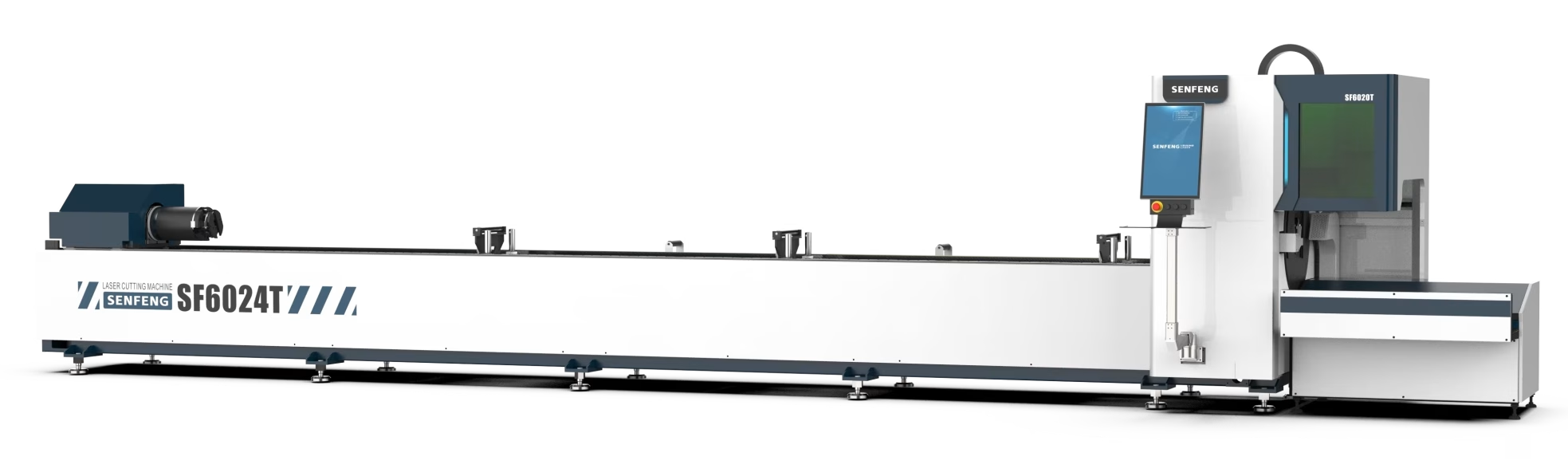
6-meter laser pipe cutter with dual T-series chucks
With advanced settings, the T series is equipped with two ultra-short-backlash pipe cutting chucks as standard. For thin-walled pipes, there is no problem of burning or slag sticking. For large-diameter pipes, high cutting speed is ensured. The equipment is quickly supplied and delivered, and is widely used in railway transportation, automobile manufacturing, construction machinery, agricultural and forestry machinery, etc.
1.5-6 [kW] Laser power
6000 [mm] Max. tube length
6-360 [mm] Tube size
80-500 [kg] Max. tube weight
Operational benefits

1. Cutting pipes of different sizes
Pipe length: 6000 mm
Round tube: Φ8360 mm, square tube: □8*8360*360 mm, rectangular tube: diagonal/side length ≤360 mm
2. Ultrashort residue (tail)
Thanks to the unique reduced-residue technology and high-precision self-centering chucks, pipes can not only be precisely clamped, but also cutting with minimal residue is ensured.
3. Multiple increase in cutting speed
Thanks to the excellent dynamic characteristics obtained thanks to its own or world-renowned components, the cutting speed of the 70% is approximately higher than that of similar models.
Maximum chuck rotation speed: 180 rpm
Maximum no-load speed: 150 m/min
4. Easy to manage
With the latest updates, we are using a new generation of intelligent software that monitors all operating parameters in real time, reducing the need for manual intervention and the likelihood of operator error.
5. Working with reflective materials
6. Wide range of applications
Advantages of mechanical design

1. Efficient drive system
The entire machine has a semi-enclosed design for operator safety and comfort. In some models, the control panel is integrated with the switchboard, ensuring a high level of integration.
2. Own laser head
Compact and lightweight design with all-optical and water cooling
3 dust-proof lenses and oil-resistant gas supply system to protect against contamination
3. Double pneumatic self-centering chucks
Square-shaped front chuck for wider grip on square and rectangular pipes
Four independent cylinders and smart legs ensure stable fixation of heavy pipes
Automatic debris and dust removal device reduces the chance of jamming and the need for manual cleaning
4. High-quality machine tool
Welded with high precision, it is characterized by stability, vibration isolation and durability
After careful welding, it undergoes heat treatment, aging, and finishing with high rigidity and long service life
5. Two types of pipe supports
The floating support moves with the pipe, supporting it throughout the cutting process.
Variable pitch supports are wear-resistant and adapt to pipes of different diameters and shapes, minimizing errors due to pipe vibrations
6. Small fiber core laser source
Compact, lightweight source with smaller fiber diameter provides better beam focusing
Electro-optical efficiency over 40%, which can significantly reduce power consumption and cutting costs
Advantages of the control system

The intelligent CNC system with EtherCAT protocol bus is easy to use, starts with a single button press. Batch import of files of various formats is supported.
1. Cutting technology library
Easily save and recall cutting patterns at any time
2. Cutting corners
Supports regular and special pipes for improved cutting quality in corners
3. Real-time deviation compensation
| Model | |||||
|---|---|---|---|---|---|
| Parameters | SF6012T | SF6016T | SF6020T | SF6024T | SF6035T |
| Laser power (kW) | 1.5–3 | 1.5–3 | 1.5–6 | 1.5–6 | 1.5–6 |
| Max. pipe length (mm) | 6000 | ||||
| Round pipes (mm) | Φ8~120 | Φ10~160 | Φ10~220 | Φ10~230 | Φ20~360 |
| Square tubes (mm) | □8×8~120×120 | □10×10~160×160 | □10×10~150×150 | □10×10~230×230 | □20×20~360×360 |
| Max. pipe weight (kg) | 120 | 160 | 200 | 250 | 500 |
| X/Y positioning accuracy (mm) | ±0.05 | ||||
| Repeatability X/Y (mm) | ±0.02 | ±0.02 | ±0.02 | ±0.03 | ±0.03 |
| Max. speed without load (m/min) | 150 | 110 | 100 | 100 | 60 |
| Max. chuck rotation (rpm) | 180 | 140 | 100 | 100 | 60 |
| Dimensions (L×W×H, mm) | 8900×2100×2100 | 8900×2100×2100 | 9260×1900×2280 | 9260×1900×2280 | 9500×2050×2550 |
| Power Supply | Three-phase, 380V, 50/60Hz | ||||
Additional benefits (optional equipment)

1. Semi-automatic and fully automatic loading and unloading systems
- Easy loading of pipes up to 6000 mm long. Supports work with round, square, rectangular pipes, as well as angles, channels and I-beams.
An automatic sorting system is available for unloading, separating finished parts and offcuts after cutting. The need for manual intervention is virtually eliminated.
What is a laser cutter and how does it work?
A laser cutter is a device that uses a laser as a heat source and is divided into sheet metal, pipe, or combined (sheet + pipe) cutting equipment. It is one of the most advanced technologies for metal processing.
The principle of operation of a laser cutter is to use a high-density laser beam, which converts the laser energy into heat. This leads to local heating, melting or even vaporization of the material. The melted or vaporized material is removed by a gas jet or other means, resulting in precise cutting.
What materials are suitable for cutting with a laser cutter?
The laser cutter can cut a wide range of materials, including stainless steel, carbon steel, alloy steel, silicon steel, aluminum, aluminum alloys, galvanized sheets, aluminum-zinc plates, annealed sheets, titanium and other metals.
These cutters are used in most metalworking industries such as sheet metal processing, kitchenware manufacturing, aerospace, electrical cabinet manufacturing, household utensils, automotive parts, construction and agricultural machinery, and many more.
How can a customer choose a laser cutter that fully meets their needs?
When choosing a laser cutter, users should pay attention to 10 main factors:
Laser power
Cutting speed
Cutting accuracy
Type of laser generator
Degree of automation and software
Cost of ownership
Material compatibility
Technical support and service
Installation space and requirements
Environmental and safety factors
What is the cutting ability of lasers with different powers?
The power of a fiber laser directly affects its cutting ability. Lasers with different power levels are suitable for different material thicknesses and types. Here is an overview of the cutting ability for the main power ranges:
1.5 kW: Suitable for cutting thin materials such as thin stainless steel, aluminum and brass, up to 6 mm thick.
3-6 kW: Ideal for most metals such as carbon steel (up to 12mm), stainless steel (up to 8mm) and aluminum (up to 6mm).
8-12 kW: Suitable for cutting thick materials such as carbon steel (up to 25 mm), stainless steel (up to 20 mm) and aluminum (up to 15 mm).
20-40 kW: Used for high-performance cutting of thick materials, including carbon steel (up to 40 mm) and stainless steel (up to 30 mm).
60-80 kW: Suitable for cutting very thick metals (up to 50 mm and more), used in heavy industrial conditions for maximum material thicknesses.
The specified laser power determines not only the possible thickness of the material to be cut, but also the cutting speed, efficiency and quality of work, making the selection of the appropriate power key to meeting specific needs.
What should you pay attention to when maintaining a laser cutter?
When maintaining a laser cutter, it is important to follow a few key points to ensure its efficient operation and long service life:
Cleanliness of optical elements: The laser beam must pass through optical components, so it is important to regularly clean the mirrors, lenses, and other elements of the optical system to ensure maximum cutting efficiency and accuracy.
Laser generator check: The laser generator must operate at the optimum power level. Regular checking and adjustment of the laser parameters ensures stable cutting quality and increases the generator's service life.
System cooling: Laser systems often require effective cooling to prevent overheating. Check the coolant level and quality to avoid overheating and component damage.
Maintenance of mechanical parts: Regular lubrication of moving parts such as guides and gears helps reduce wear and ensure positioning accuracy.
Gas system check: The gas supply system (e.g. nitrogen or oxygen) must be clean, free of contaminants, and operating at optimal levels to efficiently remove material and maintain high cut quality.
Calibration and adjustment: Regular calibration of X and Y axis positioning and repeatability ensures cutting accuracy and stability.
Security check: Make sure all safety systems are working properly, including safety doors, sensors, and emergency shutdown systems.
Replacement of worn parts: If parts such as attachments, pads or optical elements wear out, they should be replaced to maintain cutting efficiency and quality.
Regular maintenance minimizes downtime, increases efficiency, and ensures the stability of your laser cutter.
Advantages of laser cutting compared to other traditional cutting methods
Laser cutting uses an invisible laser beam instead of traditional mechanical blades, which gives it several significant advantages:
High accuracy and speed: Laser cutting provides high precision and cutting speed, allowing materials to be processed with minimal deviations and providing even, smooth edges without the need for additional processing.
No contact with the material: The mechanical parts of the laser cutter head do not come into contact with the material, which eliminates the possibility of surface damage or scratches during operation.
Low thermal impact: Laser cutting has a small heat affected zone, which allows to reduce sheet deformation and achieve narrow cutting seams (0.1-0.3 mm).
Lack of mechanical stress and burrs: Laser cutting does not create mechanical stress on the material and does not leave burrs, which greatly facilitates post-cutting processing.
High repeatability and accuracy: Laser cutting provides high precision and good repeatability without damaging the material surface, allowing for the production of identical parts with high precision.
Automation and material savings: CNC programming allows you to process any flat templates and cut large sheets without the need to manufacture molds, which significantly saves time and money, and also allows you to automatically optimize stacking to save materials.
Fast cutting without additional processing: Laser cutting provides smooth and even edges that typically do not require further processing, reducing the cost of additional processing and shortening manufacturing time.
Due to these advantages, laser cutting is gradually replacing traditional metal processing methods and becoming a popular choice for the production of high-precision and complex parts.
Warranty period of laser cutter
The complete machine is covered by a 2-year warranty. The main accessories and consumables are replaced according to their specific service life. We also provide original accessories for users worldwide, with prices provided within 24 hours and delivery within 3-7 business days. The replacement of these accessories is carried out on a priority basis through our nearest branches or local service centers.
Does the laser pipe cutting machine have an automatic correction function?
Yes. Our machines are typically equipped with advanced CNC systems that use capacitance centering to measure the actual pipe size and automatic calibration to align the pipe profile with its model. It also has a real-time pipe deviation compensation function, which reduces pipe clamping requirements and improves pipe piercing accuracy.