

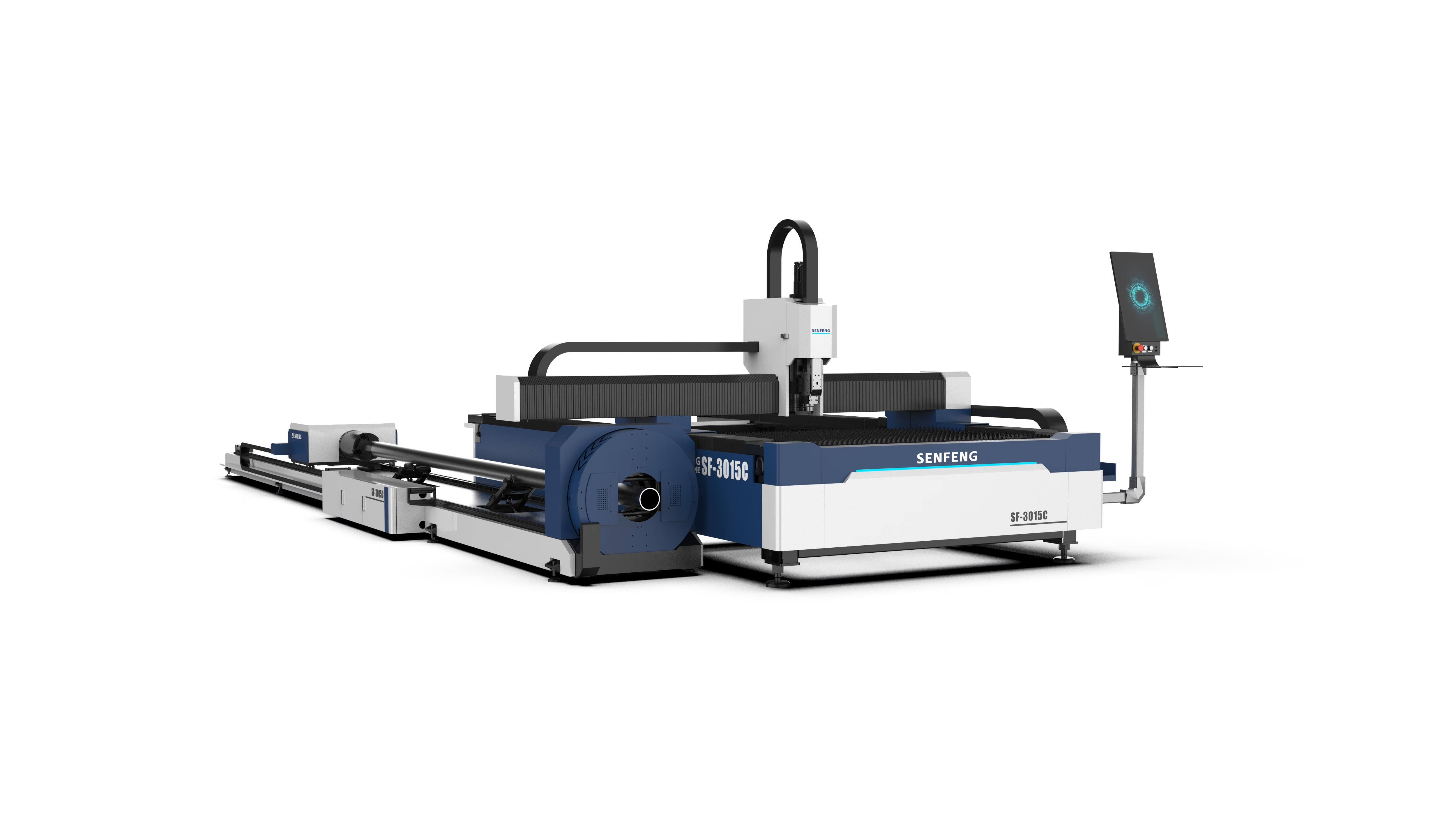

Fiber laser cutting machine for metal and pipe C series
2 475 000,00 ₴
SENFENG C series fiber laser cutting machine is a universal solution for laser cutting sheet metal and pipes on one equipment. Combining two functions in one machine allows you to expand production capabilities, save work space and reduce the cost of purchasing separate equipment.
The machine works with carbon and stainless steel, titanium and other metals. Laser power from 1.5 to 6 kW, sheet format from 3050*1530 mm, up to 6050*2030 mm. The equipment allows processing pipes with a diameter of 20 - 220 mm and a length of up to 6000 mm.
The self-aligning pneumatic chuck provides reliable pipe fixation and helps minimize material waste. High cutting speed, precise positioning and a modern CNC system will ensure consistent part quality and high productivity.
SENFENG C series is a practical choice for enterprises that need a universal laser machine for working with both sheet metal and pipes and profiles.
Laser power 1.5-6 [kW]
Sheet size: 3050*1530-6050*2030 [mm]
Pipe size: 20~220 [mm]
Max. load on sheet platform: 700 – 2000 [kg]
Productivity benefits

1. One machine — two functions
Cuts sheets with dimensions of 3050×1530 mm to 6050×2030 mm, pipes with diameters of Φ20–220 mm and lengths of 6000 mm
Works with carbon and stainless steel, aluminum alloys, brass, galvanized, silicon, electrolytic sheet, titanium and manganese alloys
2. Pipe cutting with short residual
3. High efficiency — without unnecessary hassle
Users can freely switch between sheet and pipe cutting. The speed is tens of times faster than traditional methods
One operator can control multiple machines, which saves on personnel and increases efficiency
Mechanical advantages

1. Compact design
With no top cover and four-sided barriers, materials can be loaded and unloaded from the front, rear and sides
The open design allows the operator to fully see the cutting process, respond to emergencies in a timely manner, and avoid downtime.
Designed for cutting thin sheets (≤20 mm) and relatively small pipes. Simple in design but with a high price-performance ratio even with a single workbench
2. Three in-house developed key components
We independently developed the SF-Mimir LT intelligent CNC system, SF-PowerPlus laser generator and SF-TYRFING laser head. This highly compatible set ensures fast response, high interoperability, low failure rate and easy maintenance.
3. Aircraft aluminum beam
4. Durable construction for long service life
The semi-hollow machine body is not connected internally - this prevents heat transfer and maintains cutting accuracy
The frame does not deform or collapse at high temperature even after long-term use by undergoing 7 standard treatments such as high annealing and aging
Advantages of the control system

1. Lightning piercing
2. Centering the disc
3. Flying cutting with one push
| Parameters | Models | ||||
|---|---|---|---|---|---|
| SF3015C | SF4015C | SF4020C | SF6015C | SF6020C | |
| Laser power (kW) | 1.5–6 | 1.5–6 | 1.5–6 | 1.5–6 | 1.5–6 |
| Working area (L × W, mm) | 3050 × 1530 | 4050 × 1530 | 4050 × 2030 | 6050 × 1530 | 6050 × 2030 |
| X/Y positioning accuracy (mm) | ±0.05 | ±0.05 | ±0.05 | ±0.05 | ±0.05 |
| X/Y repositioning accuracy (mm) | ±0.02 | ±0.02 | ±0.02 | ±0.02 | ±0.02 |
| Maximum idle speed (m/min) | 100 | 100 | 100 | 100 | 100 |
| Round pipe diameter (mm) | 20–220 | 20–220 | 20–220 | 20–220 | 20–220 |
| Pipe length (mm) | 500–6000 | 500–6000 | 500–6000 | 500–6000 | 500–6000 |
| Max. platform load (kg) | 700 | 950 | 1250 | 1400 | 2000 |
| Dimensions (L × W × H, mm) | 8500 × 3740 × 2100 | 8500 × 3740 × 2100 | 8600 × 4200 × 2100 | 8800 × 3740 × 2100 | 8800 × 4200 × 2100 |
| Power Supply | Three-phase 380V, 50Hz/60Hz | ||||
Additional benefits

1. Servo robotic arm for loading
What is a laser cutter and how does it work?
A laser cutter is a device that uses a laser as a heat source and is divided into sheet metal, pipe, or combined (sheet + pipe) cutting equipment. It is one of the most advanced technologies for metal processing.
The principle of operation of a laser cutter is to use a high-density laser beam, which converts the laser energy into heat. This leads to local heating, melting or even vaporization of the material. The melted or vaporized material is removed by a gas jet or other means, resulting in precise cutting.
What materials are suitable for cutting with a laser cutter?
The laser cutter can cut a wide range of materials, including stainless steel, carbon steel, alloy steel, silicon steel, aluminum, aluminum alloys, galvanized sheets, aluminum-zinc plates, annealed sheets, titanium and other metals.
These cutters are used in most metalworking industries such as sheet metal processing, kitchenware manufacturing, aerospace, electrical cabinet manufacturing, household utensils, automotive parts, construction and agricultural machinery, and many more.
How can a customer choose a laser cutter that fully meets their needs?
When choosing a laser cutter, users should pay attention to 10 main factors:
Laser power
Cutting speed
Cutting accuracy
Type of laser generator
Degree of automation and software
Cost of ownership
Material compatibility
Technical support and service
Installation space and requirements
Environmental and safety factors
What is the cutting ability of lasers with different powers?
The power of a fiber laser directly affects its cutting ability. Lasers with different power levels are suitable for different material thicknesses and types. Here is an overview of the cutting ability for the main power ranges:
1.5 kW: Suitable for cutting thin materials such as thin stainless steel, aluminum and brass, up to 6 mm thick.
3-6 kW: Ideal for most metals such as carbon steel (up to 12mm), stainless steel (up to 8mm) and aluminum (up to 6mm).
8-12 kW: Suitable for cutting thick materials such as carbon steel (up to 25 mm), stainless steel (up to 20 mm) and aluminum (up to 15 mm).
20-40 kW: Used for high-performance cutting of thick materials, including carbon steel (up to 40 mm) and stainless steel (up to 30 mm).
60-80 kW: Suitable for cutting very thick metals (up to 50 mm and more), used in heavy industrial conditions for maximum material thicknesses.
The specified laser power determines not only the possible thickness of the material to be cut, but also the cutting speed, efficiency and quality of work, making the selection of the appropriate power key to meeting specific needs.
What should you pay attention to when maintaining a laser cutter?
When maintaining a laser cutter, it is important to follow a few key points to ensure its efficient operation and long service life:
Cleanliness of optical elements: The laser beam must pass through optical components, so it is important to regularly clean the mirrors, lenses, and other elements of the optical system to ensure maximum cutting efficiency and accuracy.
Laser generator check: The laser generator must operate at the optimum power level. Regular checking and adjustment of the laser parameters ensures stable cutting quality and increases the generator's service life.
System cooling: Laser systems often require effective cooling to prevent overheating. Check the coolant level and quality to avoid overheating and component damage.
Maintenance of mechanical parts: Regular lubrication of moving parts such as guides and gears helps reduce wear and ensure positioning accuracy.
Gas system check: The gas supply system (e.g. nitrogen or oxygen) must be clean, free of contaminants, and operating at optimal levels to efficiently remove material and maintain high cut quality.
Calibration and adjustment: Regular calibration of X and Y axis positioning and repeatability ensures cutting accuracy and stability.
Security check: Make sure all safety systems are working properly, including safety doors, sensors, and emergency shutdown systems.
Replacement of worn parts: If parts such as attachments, pads or optical elements wear out, they should be replaced to maintain cutting efficiency and quality.
Regular maintenance minimizes downtime, increases efficiency, and ensures the stability of your laser cutter.
Advantages of laser cutting compared to other traditional cutting methods
Laser cutting uses an invisible laser beam instead of traditional mechanical blades, which gives it several significant advantages:
High accuracy and speed: Laser cutting provides high precision and cutting speed, allowing materials to be processed with minimal deviations and providing even, smooth edges without the need for additional processing.
No contact with the material: The mechanical parts of the laser cutter head do not come into contact with the material, which eliminates the possibility of surface damage or scratches during operation.
Low thermal impact: Laser cutting has a small heat affected zone, which allows to reduce sheet deformation and achieve narrow cutting seams (0.1-0.3 mm).
Lack of mechanical stress and burrs: Laser cutting does not create mechanical stress on the material and does not leave burrs, which greatly facilitates post-cutting processing.
High repeatability and accuracy: Laser cutting provides high precision and good repeatability without damaging the material surface, allowing for the production of identical parts with high precision.
Automation and material savings: CNC programming allows you to process any flat templates and cut large sheets without the need to manufacture molds, which significantly saves time and money, and also allows you to automatically optimize stacking to save materials.
Fast cutting without additional processing: Laser cutting provides smooth and even edges that typically do not require further processing, reducing the cost of additional processing and shortening manufacturing time.
Due to these advantages, laser cutting is gradually replacing traditional metal processing methods and becoming a popular choice for the production of high-precision and complex parts.
Warranty period of laser cutter
The complete machine is covered by a 2-year warranty. The main accessories and consumables are replaced according to their specific service life. We also provide original accessories for users worldwide, with prices provided within 24 hours and delivery within 3-7 business days. The replacement of these accessories is carried out on a priority basis through our nearest branches or local service centers.
Does the laser pipe cutting machine have an automatic correction function?
Yes. Our machines are typically equipped with advanced CNC systems that use capacitance centering to measure the actual pipe size and automatic calibration to align the pipe profile with its model. It also has a real-time pipe deviation compensation function, which reduces pipe clamping requirements and improves pipe piercing accuracy.